How Science and Creativity Point to God
Oct 27, 2026The Divine Draftsman: Leonardo da Vinci
How Reason and Creativity Intersect—and What They Reveal About the Creator
Leonardo da Vinci, faith and reason, science and faith, creativity and God, design in creation, Renaissance, Christian worldview
What if the boundary between a scientific observation and a worshipful prayer is thinner than the stroke of a paintbrush?
When Science and Beauty Meet
Leonardo da Vinci is remembered as one of history’s greatest artists, but calling him simply an artist barely begins to describe the breadth of his mind. He was a painter, anatomist, engineer, inventor, mathematician, cartographer, botanist, architect, and relentless observer of the natural world.
What makes Leonardo especially fascinating for a Christian exploration of faith and reason is that he did not see a sharp line between understanding how something works and appreciating its beauty. A bird’s wing could be a study in physics and a source of wonder. The human heart could be an anatomical structure and an extraordinary work of design. A painting could require both artistic imagination and mathematical precision.
His life raises a question that remains important today: Do science and faith have to compete, or can reason and creativity point toward the same Creator?
In A Case for God — Week 43, we open the case file on Leonardo da Vinci, the “Divine Draftsman,” and explore how curiosity, beauty, order, and scientific observation can become a pathway toward wonder.
👉Watch the Full Leonardo da Vinci Lesson
The full lesson goes much deeper into Leonardo’s life, his notebooks, his anatomical studies, his art, and the question of how reason and creativity intersect.
👉▶ WATCH THE FULL YOUTUBE LESSON
As you watch, consider this question: What if the universe is not merely a machine that works, but a masterpiece that speaks?
Who Was Leonardo da Vinci?
Leonardo di ser Piero da Vinci lived from 1452 to 1519 and became the quintessential Renaissance polymath. His interests stretched across disciplines that we often separate today: painting, anatomy, engineering, mathematics, architecture, botany, geology, mechanics, music, and invention.
Born out of wedlock and without the conventional academic education expected of a great scholar, Leonardo developed his abilities through observation, experimentation, drawing, and relentless curiosity.
His surviving notebooks reveal a mind that rarely stopped asking questions: How does water move? How does light behave? How does a muscle create movement? How does a bird generate lift? How does the heart move blood?
For Leonardo, looking closely was part of learning. His sketchbooks became laboratories on paper—places where art and scientific investigation met.
The Gift of Craftsmanship
“...and he has filled him with the Spirit of God, with skill, with intelligence, with knowledge, and with all craftsmanship...” — Exodus 35:31–32 (ESV)
This passage challenges the idea that creativity and technical skill are somehow separate from spiritual life. Scripture presents craftsmanship, intelligence, knowledge, and artistic design as gifts that can be used for God’s purposes.
Leonardo’s life gives us a vivid example of what it can look like when a person refuses to stop learning. His ability to observe, calculate, sketch, build, and create reflects the remarkable capacity God has given human beings to discover, develop, and make.
Creativity does not have to compete with faith. Used rightly, it can become an expression of gratitude for the Creator who gave us minds capable of creating.
The Honor of Searching Things Out
“It is the glory of God to conceal things, but the glory of kings is to search things out.” — Proverbs 25:2 (ESV)
Leonardo spent much of his life searching things out. He studied water, anatomy, plants, flight, light, perspective, movement, and proportion.
This verse gives us a helpful perspective on curiosity. Asking questions is not necessarily a sign of weak faith. Investigation can be an expression of wonder.
When we ask how a heart beats, how a flower develops, how light travels, or why mathematical patterns appear throughout nature, we are engaging with a world filled with questions.
For a Christian, the goal is not to worship creation instead of the Creator. It is to allow our study of creation to deepen our wonder toward the One who made it.
The Logos: The Logic Behind Creation
“All things were made through him, and without him was not any thing made that was made.” — John 1:3 (ESV)
John introduces Jesus as the Logos—the Word. The concept carries ideas of reason, order, meaning, and intelligibility.
If creation comes through the Logos, then the universe is not fundamentally irrational. It can be investigated, measured, described, and studied.
This helps explain why the pursuit of science does not automatically have to lead away from faith. Studying the mechanisms of creation can become an investigation into the order embedded within creation.
Leonardo’s work embodies this idea. He did not merely admire the human body; he investigated it. He did not merely look at birds; he studied flight. He did not merely paint light; he examined how light behaves.
Can Beauty Point Us Toward God?
“For his invisible attributes, namely, his eternal power and divine nature, have been clearly perceived... in the things that have been made.” — Romans 1:20 (ESV)
Romans 1:20 presents creation as a witness. The visible world can point us toward qualities of the invisible Creator.
This does not mean every scientific discovery automatically proves every Christian doctrine. It does mean that order, beauty, intelligibility, and complexity can invite deeper philosophical questions.
Why is the universe understandable? Why does mathematics describe nature so effectively? Why do we experience beauty? Why do human beings have such a profound capacity to create, recognize patterns, and search for meaning?
Leonardo’s work brings these questions together. The more carefully he observed the world, the more he encountered both mathematical structure and extraordinary beauty.
Leonardo’s Greatest Lesson: Don’t Choose Between Logic and Beauty
One of the most important lessons from Leonardo’s life is that reason and creativity do not have to be enemies.
We sometimes divide people into categories: analytical or artistic, scientific or spiritual, logical or creative. Leonardo’s life challenges that division.
A mathematical equation can be elegant. A scientific discovery can be beautiful. A painting can require engineering. Anatomy can inspire awe.
Think of reason and creativity as two eyes looking at one world. Reason helps us understand structure. Creativity helps us perceive meaning, beauty, relationship, and possibility. Together, they can give us a richer view of creation.
Leonardo and the Human Body
Leonardo’s anatomical studies are among the clearest examples of his commitment to extreme observation. He studied muscles, bones, organs, blood vessels, and proportions. His drawings reveal an extraordinary effort to understand what lies beneath the surface.
The Vitruvian Man became one of the most recognizable images associated with Renaissance thought, combining art, geometry, proportion, and the human form.
For Leonardo, anatomy was not simply a collection of facts. It was an encounter with remarkable structure.
The human body illustrates the question at the heart of this lesson: How can something be both functional and beautiful? A heart has a job to do. A hand has a function. A human eye processes light. Yet the same body can inspire art, poetry, wonder, and worship.
The Last Supper: When Technical Skill Serves a Spiritual Story
Leonardo’s The Last Supper provides another powerful example of the intersection of reason and creativity.
The work required technical knowledge of perspective, composition, proportion, light, architecture, and human expression. Yet those technical skills were placed in service of a profoundly spiritual scene.
Leonardo used artistic technique to draw the viewer into the biblical moment.
Our gifts do not have to look overtly religious to honor God. A designer can create with excellence. A scientist can investigate with integrity. A teacher can explain complex ideas clearly. An engineer can solve problems creatively. An artist can reveal beauty.
The question is not simply what talent we have. It is what we do with it.
The Mystery of Leonardo’s Unfinished Work
Leonardo left many projects incomplete. Some paintings remained unfinished. Some inventions stayed on paper. Some ideas were never fully developed.
At first glance, unfinished work might look like failure. But Leonardo’s imagination often moved faster than his ability to complete everything he envisioned.
That tension can remind us that human creativity is limited. We can imagine more than we can accomplish. We can see possibilities that we cannot fully realize.
Our work may be unfinished, but that does not make it meaningless. It can remind us that we are creatures—not the Creator. We discover, build, imagine, and create, but we remain finite.
Does Science Threaten Faith?
For many people today, science and faith are presented as opposing camps. You must supposedly choose between believing in God and believing in evidence.
Leonardo’s life complicates that assumption. He demonstrates that intense observation of the natural world can coexist with an appreciation for beauty, meaning, and spiritual questions.
Christianity does not require believers to stop asking how things work. Science can help us understand mechanisms and describe processes, while larger questions about ultimate meaning, purpose, value, beauty, and why there is a rational universe to investigate reach into philosophy and theology.
The goal is not to make science prove what it cannot prove. The goal is to recognize that scientific investigation and faith can occupy different but complementary levels of questioning.
Curiosity Can Be a Spiritual Discipline
Leonardo’s life also challenges the idea that curiosity is dangerous. Sometimes Christians worry that asking too many questions means we are doubting God. But mature faith does not require intellectual laziness.
Curiosity can become a spiritual discipline when it is rooted in humility. Instead of saying, “I already know everything,” curiosity says, “There is more here to discover.”
That posture can lead us toward worship. Look closely at a leaf. Study the night sky. Learn how the human eye works. Pay attention to the architecture of a flower. Explore mathematics. Ask questions.
Then allow wonder to lead you beyond the object itself. What does this reveal about the world? What does it reveal about us? And what might it reveal about the God who made it?
Worshipping Creation vs. Seeing the Creator
There is an important caution here. Admiring creation is not the same thing as worshipping creation.
The beauty of nature can point beyond itself, but nature itself is not God.
Leonardo’s work gives us an opportunity to hold both ideas together: study creation carefully and remain attentive to the Creator. Wonder can stop at the created thing, or it can awaken gratitude toward its Source.
Leonardo and the Question of Faith
It is important to acknowledge that Leonardo’s personal beliefs remain a subject of historical discussion. His notebooks contain extensive scientific and technical observations, while historians continue to debate the exact nature and depth of his personal faith.
Many of his religious works were created within the patronage culture of Renaissance Italy, so it is difficult to determine how every religious subject reflected personal conviction.
What we can clearly see is a person captivated by the intelligibility and beauty of the natural world. The deeper question is what that beauty means—and whether the order we discover in creation ultimately points beyond itself.
Jesus: The Ultimate Intersection of Reason and Revelation
The deepest Christian connection in this lesson is the concept of the Logos. John 1 does not describe ultimate reality as an impersonal equation. The Word through whom creation came into being is presented as a Person.
Leonardo spent his life trying to reveal hidden structures: the mechanics of a heart, the movement of water, the flight of a bird, the expression on a human face.
Jesus came to reveal something even deeper: the heart of the Father. In Christ, Christians believe that the Creator enters His creation to make Himself known.
The God behind the beauty is not distant from us. He invites us to know Him.
One Life Lesson: Practice the Art of Noticing
You don’t have to be Leonardo da Vinci to cultivate wonder. You simply have to slow down enough to notice.
This week, practice the “art of noticing.” When you see a sunrise, pause. When you hear music, listen carefully. When you solve a difficult problem, recognize the creativity involved. When you cook, design, teach, build, write, calculate, organize, or create, remember that your capacity to think and make is itself a gift.
You can turn ordinary curiosity into gratitude. Let your knowledge become wonder. Let your wonder become worship.
Look closely. Ask questions. Let wonder become worship.
Did You Know? Leonardo and the Human Heart
One fascinating part of Leonardo’s anatomical research was his investigation into the heart and blood flow. He created models and used water and particles to observe fluid movement, developing insights into how vortices influence the behavior of blood near the heart valves.
His work illustrates the extraordinary patience behind his observations. He did not simply accept what others said about anatomy. He investigated it.
That is the spirit of the lesson: don’t merely glance at creation. Look closely enough to discover what is there.
What Leonardo da Vinci Can Teach Us About Faith and Reason
Leonardo’s legacy challenges the assumption that you must choose between a thinking mind and a believing heart.
You can ask difficult questions and still have faith. You can love mathematics and love God. You can study science and be filled with wonder. You can create art and see it as a reflection of the Creator.
You can investigate the world without losing your sense of worship. Your curiosity may become one of the ways you grow in appreciation for God’s creation.
A Challenge for This Week
Choose one ordinary thing and investigate it. It could be a flower, a recipe, a musical instrument, the night sky, your own heartbeat, the architecture of a building, or a problem you encounter at work.
Instead of simply looking, ask questions. How does it work? Why is it structured this way? What makes it beautiful? What can I learn from it?
Then take one more step: thank God for the ability to notice. Let your investigation become gratitude. Let your knowledge become wonder. Let your wonder become worship.
👉Watch the Full A Case for God Lesson👈
There is so much more to explore in Leonardo’s story, from his Renaissance workshop and notebooks to his anatomical drawings, engineering ideas, paintings, and approach to observation.
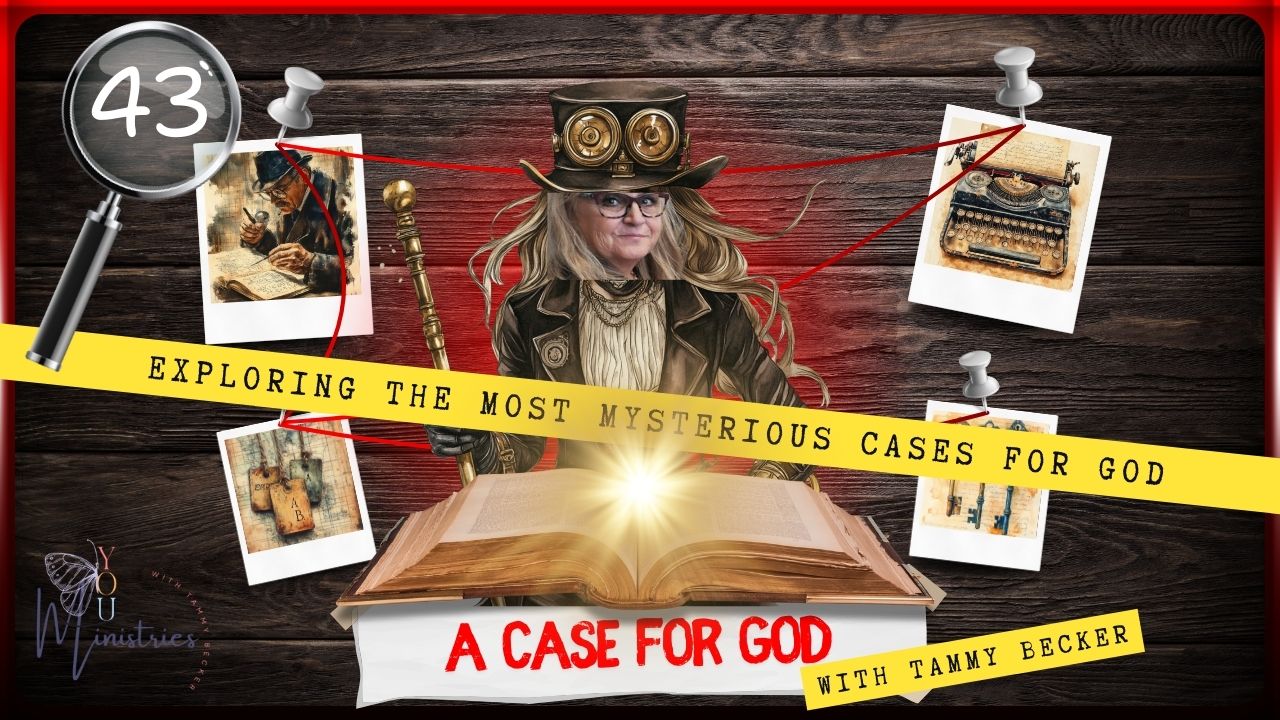
In A Case for God — Week 43, Tammy takes us deeper into the question of how reason and creativity intersect and what Leonardo’s life can teach us about science, beauty, faith, and the Creator.
👉▶ WATCH THE FULL “LEONARDO DA VINCI” LESSON ON YOUTUBE
As you watch, ask yourself: Do you find it easier to see God in the mathematical precision of creation or in its breathtaking beauty?
Keep Exploring Your Faith With the Faith Pod
Questions about God do not have to end when the video ends.
If this lesson has made you curious about faith, science, Scripture, purpose, or the evidence for Christianity, we invite you to continue the conversation through the Faith Pod.
The Faith Pod is an opportunity to go deeper, ask honest questions, grow in your understanding of faith, and connect with others who are also seeking to know God more deeply.
You don’t have to have every answer before joining the conversation. You simply need a willingness to learn, explore, and grow.

Final Thought: Look Again
Leonardo da Vinci spent his life looking. He looked at the human body, water, birds, light, faces, movement, proportion, structure, and beauty.
And his example gives us a challenge: look again.
Look beyond the surface. Look closely enough to discover the order. Look deeply enough to notice the beauty. And then ask the bigger question: What does all of this tell us about the One who made it?
Reason and creativity do not have to pull us in opposite directions. They can become two ways of seeing the same world.
The scientist asks, “How does it work?” The artist asks, “Why is it beautiful?” The person of faith can ask both—and then ask one more question:
“Who made it?”
Perhaps the more carefully we investigate the world, the more reasons we find to stand in awe of its Creator.
Next Week on A Case for God: Harriet Tubman
Next week, our investigation moves from the drawing boards of the Renaissance to the secret paths of the Underground Railroad. We open the case file on Harriet Tubman, a woman whose courage and faith helped her repeatedly confront extraordinary danger.
We will investigate the question: How does faith serve as a source of empowerment? Was Harriet Tubman’s internal compass simply an extraordinary sense of direction, or was she responding to the voice of God?
Join us as we explore the life of “Moses,” a woman whose faith became a source of courage, freedom, and action.

CHECK OUT THE FULL CAMPFIRE EXPERIENCE HERE:
Make sure to read through the entire page because somewhere along the trail....there lies a FREEBIE for he taking!
Download a FREE digital Bible Journaling Page for the Prophetic Pattern
Share your design talents with the world.


Founder YOU Ministries