A Christian Goal-Setting Guide for the New Year
Nov 09, 2026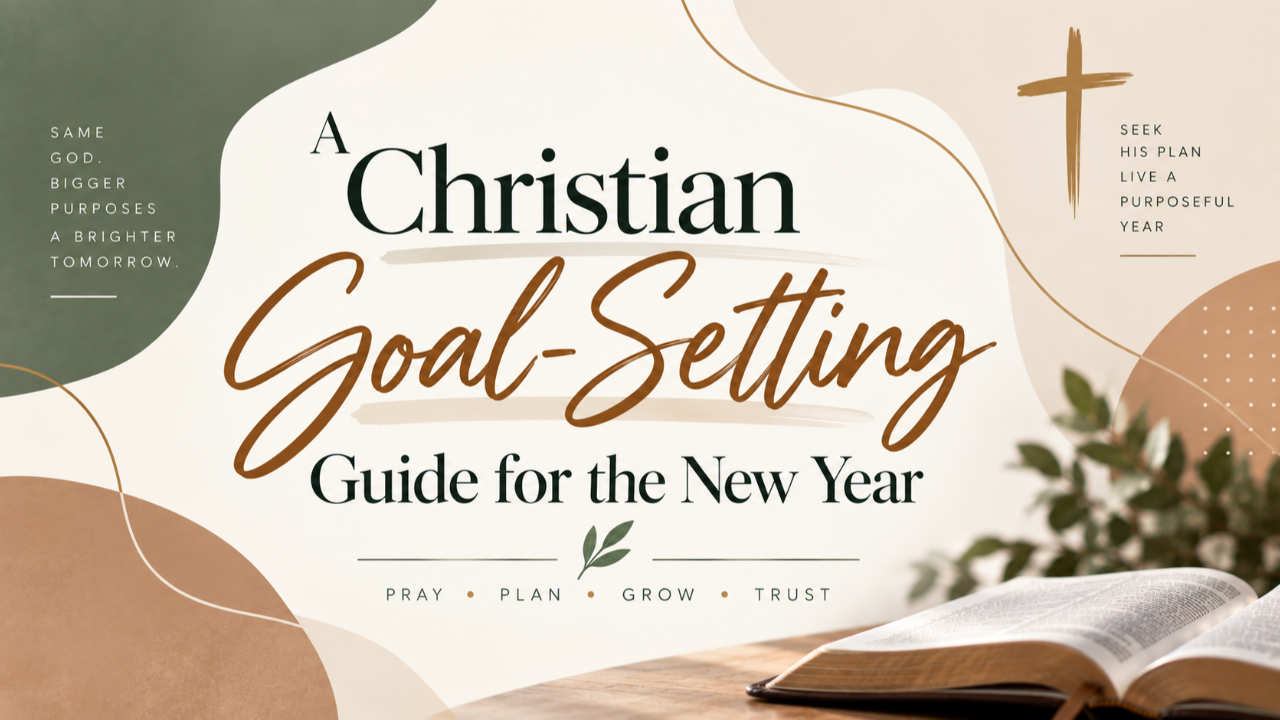
There’s something about the beginning of a new year that makes us want to start fresh.
We pull out a new calendar. We think about what we want to change. Maybe we make a list of goals, choose a word for the year, or begin imagining what the next twelve months might look like.
And honestly, I love that feeling.
There is something hopeful about a blank page.
But as Christians, I think there is another question we can ask before we start filling that page.
God, what do You want to do in me this year?
Not just, What do I want to accomplish?
Not just, What do I need to fix?
Not even just, What are my goals?
But, Lord, where are You leading me?
That small shift can change the way we approach the entire year.
Christian goal-setting isn’t about creating the perfect plan and then working hard enough to make everything happen. It’s about bringing our hopes, plans, dreams, responsibilities, and desires before God and allowing Him to guide our steps.
So before you grab your planner and start writing down everything you want to accomplish this year, let’s slow down for a moment.
Let’s begin with Jesus.
Start With Prayer, Not Pressure
One of the easiest things to do at the beginning of a new year is to put pressure on ourselves.
We look at everything we didn’t finish last year.
The habits we didn’t build.
The books we didn’t read.
The Bible study plans we didn’t complete.
The projects that never got finished.
The goals that seemed so important in January but were forgotten by March.
And then we decide that this year will be different.
Maybe it will be.
But it doesn’t have to begin with pressure.
It can begin with prayer.
Proverbs 3:5–6 reminds us to trust the Lord rather than leaning completely on our own understanding and to acknowledge Him in all our ways.
That includes our goals.
Before asking, “What do I want to accomplish?” try asking:
“Lord, what would You like me to focus on in this season?”
That is a different kind of question.
It creates room for God.
Your Goals Don't Have to Look Like Everyone Else's
We live in a world filled with goal lists.
Someone wants to run a marathon.
Someone else wants to launch a business.
Another person wants to travel to five countries.
Someone wants to renovate their home.
Someone wants to write a book.
Someone wants to lose weight, save money, start a new hobby, or completely reinvent themselves.
There is nothing wrong with having goals.
But comparison can quietly sneak into the process.
You may begin setting goals because everyone around you seems to be accomplishing more.
That’s when it’s time to step back.
God has not asked you to live someone else’s life.
Your season may look completely different from the person sitting next to you.
Maybe this is a year of building.
Maybe it’s a year of healing.
Maybe it’s a year of learning.
Maybe it’s a year of serving.
Maybe it’s a year of resting.
Maybe God is asking you to simplify.
Maybe He is inviting you to become more deeply rooted in Him before you move into something new.
So don't measure your goals against someone else's timeline.
Ask God what faithfulness looks like for you.
Ask What God Wants to Grow in You
I love the picture Jesus gives us in John 15.
Jesus talks about abiding in Him and bearing fruit.
Notice the order.
We don't produce fruit by simply trying harder.
We stay connected to Jesus.
We abide.
And fruit grows from that relationship.
That changes how we think about goals.
Instead of beginning with a list of accomplishments, we can begin by asking:
What kind of person is God inviting me to become?
Maybe you want to read the Bible more consistently.
That's a wonderful goal.
But perhaps underneath that goal is a deeper desire to know God more intimately.
Maybe you want to become more patient.
Maybe the deeper goal is learning to trust God when things don't move according to your timeline.
Maybe you want to become more generous.
Maybe God is growing gratitude and contentment in your heart.
Maybe you want to spend more time with your family.
Maybe the deeper invitation is to become more present.
The goal matters.
But the person God is shaping through the process matters too.
Set Spiritual Goals That Help You Draw Near to God
When we think about Christian goals, it's easy to create goals that sound spiritual but still feel like another checklist.
Read the Bible every single day.
Pray for an hour every morning.
Memorize one verse every week.
Complete twelve Bible studies.
Read the entire Bible in three months.
Again, none of these things are bad.
But what happens when life gets busy?
What happens when you miss a morning?
What happens when your schedule changes?
What happens when you're exhausted?
Sometimes we turn a good spiritual practice into a measure of whether we're doing “well” with God.
That's not what Jesus is asking from us.
Instead, consider creating simple spiritual goals that encourage relationship.
For example:
Instead of: “I will read five chapters of the Bible every morning.”
Try: “I will make consistent time to meet with God in Scripture.”
Instead of: “I will pray for one hour every day.”
Try: “I will build a daily rhythm of prayer.”
Instead of: “I will memorize 52 verses.”
Try: “I will slow down enough to meditate on Scripture and carry God's Word with me.”
The goal isn't perfection.
The goal is connection.
Think About the Areas of Your Life God Has Entrusted to You
Christian goal-setting isn't only about spiritual habits.
God cares about every part of our lives.
Your family matters.
Your work matters.
Your finances matter.
Your health matters.
Your relationships matter.
Your time matters.
Your gifts matter.
Your home matters.
Your ministry matters.
Your rest matters.
Take some time to prayerfully consider the different areas God has entrusted to you.
You might ask:
My relationship with God:
What would help me grow closer to Him?
My family:
How can I become more present and intentional?
My relationships:
Is there someone I need to forgive, encourage, or reconnect with?
My work:
How can I honor God through the work He has given me?
My finances:
What would faithful stewardship look like this year?
My health:
How can I care for the body God has entrusted to me?
My creativity:
What gifts has God placed in me that I might be called to use?
My service:
Where might God be inviting me to love and serve others?
You don't need a goal in every category.
In fact, you probably shouldn't have twenty-five goals.
Sometimes fewer goals create more room for faithfulness.
Choose Goals That Are Faithful, Not Just Impressive
Let's be honest.
Some goals look really good on paper.
They sound impressive.
But that doesn't mean they're the goals God is asking you to pursue.
A smaller goal done faithfully may be more meaningful than a huge goal that leaves you exhausted.
Maybe your goal is to sit with your Bible for fifteen minutes each morning.
Maybe it's to call your mom once a week.
Maybe it's to save a small amount of money each month.
Maybe it's to finally finish the project God has been putting on your heart.
Maybe it's to create margin in your schedule.
Maybe it's to stop saying yes to everything.
Maybe it's to learn how to rest without feeling guilty.
God isn't impressed by how complicated our goals are.
He is interested in our hearts.
Make Room for God's Redirection
One of the most important parts of Christian goal-setting is remembering that our plans are not God's plans.
Proverbs 16:9 reminds us that we may make plans, but the Lord establishes our steps.
I think this is where faith becomes very practical.
We can make plans.
We should make plans.
But we hold them with open hands.
Because sometimes God redirects us.
A door closes.
A relationship changes.
An opportunity appears that we never expected.
A responsibility comes into our lives.
Our priorities shift.
Something we thought would happen doesn't.
And suddenly our carefully written plan doesn't look quite the same.
That doesn't mean the year has failed.
It may simply mean God is leading us somewhere we didn't anticipate.
So when you write your goals, leave room for God to interrupt them.
Don't Forget the Goal of Becoming More Like Jesus
There is one goal that should quietly shape all the others.
Becoming more like Jesus.
Galatians 5:22–23 gives us the fruit of the Spirit: love, joy, peace, patience, kindness, goodness, faithfulness, gentleness, and self-control.
Imagine if those became the measuring stick for your year.
Not simply:
How much did I accomplish?
But:
Did I become more patient?
Did I grow in love?
Did I learn to trust God more?
Did I become quicker to forgive?
Did I become more generous?
Did I learn to rest?
Did I become more faithful in the small things?
Those questions reach much deeper than a traditional goal list.
Because at the end of the year, you may not accomplish everything you planned.
But you may discover that God has grown something beautiful in you.
And that matters.
Create a Simple Christian Goal-Setting Process
If you're ready to sit down and prayerfully plan your year, here's a simple process you can use.
1. Look Back With Gratitude
Before looking ahead, look back.
Where did you see God?
What prayers did He answer?
What did you learn?
What difficult season did He carry you through?
What blessings did you almost overlook?
Take some time to thank Him.
2. Release What Needs to Stay Behind
You don't need to carry everything from last year into this one.
Maybe there is disappointment.
Maybe regret.
Maybe something didn't work out.
Maybe you made mistakes.
Bring those things to Jesus.
Ask Him what you need to learn, what you need to release, and what you need to leave behind.
3. Pray About the Year Ahead
Don't rush this part.
Sit quietly.
Ask God:
“What are You inviting me into?”
“What do You want to grow in me?”
“Where do I need to trust You?”
“What needs my attention?”
“What needs to be released?”
Write down what comes to mind.
4. Choose a Few Meaningful Goals
Choose a small number of goals that reflect what God is putting on your heart.
Make them realistic.
Make them specific.
But most importantly, make them faithful.
5. Connect Each Goal to Scripture
This is one of my favorite ways to keep goals centered on God.
If your goal is to trust God more, choose a Scripture about trust.
If your goal is to grow in patience, choose a passage about patience.
If your goal is to become more generous, find Scripture that reminds you of God's generosity.
Let God's Word shape your motivation.
6. Pray Over Your Goals
Don't just write your goals.
Pray over them.
Ask God to give you wisdom.
Ask Him to close doors that aren't right.
Ask Him to give you perseverance.
Ask Him to help you recognize when He is redirecting you.
And surrender the outcome to Him.
What If You Don't Reach Every Goal?
This is important.
What if December comes and you realize you didn't accomplish everything you wrote down in January?
Give yourself grace.
You are not a failure.
God is not disappointed in you because your year didn't go according to plan.
Life happens.
Seasons change.
Priorities shift.
Sometimes God answers prayers in ways we didn't expect.
Sometimes the thing we thought was a setback becomes part of what He uses to grow us.
So don't measure your entire year by a checklist.
Look for God's faithfulness.
Look for growth.
Look for lessons.
Look for answered prayers.
Look for the ways He carried you.
Look for the fruit.
Because sometimes the greatest work God does in us isn't something we can put on a goal sheet.
A Few Christian Goal-Setting Questions to Journal
Before you finish planning your year, take a quiet moment with these questions:
- Where did I see God's faithfulness last year?
- What am I most grateful for?
- What do I need to surrender to God?
- What am I carrying that God may be asking me to release?
- What area of my life needs more prayer?
- What spiritual habit would help me stay connected to Jesus?
- What relationship needs more intentional attention?
- What gift or ability might God be asking me to use?
- What does faithfulness look like in this season?
- What do I want to learn about God this year?
- What fruit of the Spirit do I especially want God to grow in me?
- What would it look like to leave room for God's interruptions?
- What is one simple step of obedience I can take this month?
Don't worry about answering all of them at once.
Take your time.
Let the questions sit with you.
A Prayer for Your New Year
Father,
thank You for bringing me into another year.
Thank You for everything You taught me in the year behind me, even the things I didn't understand at the time.
As I look toward the year ahead, help me not to rush into making plans without first seeking You.
Show me what You want me to focus on.
Show me what I need to release.
Show me where I need to grow.
Give me wisdom for the decisions ahead and courage to follow You when Your direction looks different from what I expected.
Help me set goals that honor You.
Help me remain faithful in the small things.
Teach me to hold my plans with open hands.
And when You redirect me, help me trust that Your ways are better than mine.
Most of all, help me stay close to Jesus.
Let my greatest goal be knowing You more, trusting You more, and becoming more like Christ.
Guide my steps throughout this year.
In Jesus' name, amen.
Let This Year Be About Faithfulness
As you think about the New Year, I want to encourage you not to make the year bigger than it needs to be.
You don't have to reinvent yourself.
You don't have to become a completely different person by January 31.
You don't have to accomplish everything at once.
You can simply begin.
One prayer.
One Scripture.
One faithful step.
One act of obedience.
One conversation.
One moment of choosing trust instead of fear.
One day at a time.
God is not asking you to know everything that will happen this year.
He is asking you to walk with Him.
And that may be the most important goal of all.
Ready to Plan the Year Ahead?
If you're getting ready for a new season and want a simple way to bring your plans, celebrations, and preparations together, the Christmas Planner 2026 can help you stay organized without losing sight of what matters most.
Use it as a practical planning tool while also creating space to slow down, reflect, and prepare your heart for the season.
You can use the Christmas Planner 2026 to help bring a little more peace and intention to your holiday planning.
Come Sit Around the Campfire
And if you're looking for a faith-filled way to continue growing with others, I also want to invite you to experience The Campfire Experience 2027.

There's something special about gathering around a campfire.
You slow down.
You listen.
You share.
You remember that you aren't walking alone.
That's the heart behind the Campfire Experience—a space to draw closer to God, grow in faith, and make room for meaningful reflection and connection.
As you step into a new year, don't just ask what you want to accomplish.
Ask what God wants to grow.
Ask where He is leading.
And then take the next faithful step.
You don't need to see the whole road.
You just need to trust the One who does.

CHECK OUT THE FULL CAMPFIRE EXPERIENCE HERE:
Make sure to read through the entire page because somewhere along the trail....there lies a FREEBIE for he taking!
Download a FREE digital Bible Journaling Page for the Prophetic Pattern
Share your design talents with the world.


Founder YOU Ministries